

Energy costs are rising. Are they holding back your growth plans?

For many large organisations, energy has shifted from a predictable operational cost to a major strategic concern. Geopolitical conflicts and ongoing uncertainty in global energy markets trigger volatility in energy supply and pricing. For businesses running large estates, these fluctuations can translate into significant increases in operating costs, affecting budgets that might otherwise be directed toward innovation, expansion or digital transformation.
At the same time, organisations are under growing pressure to meet sustainability commitments and reduce carbon emissions. Managing energy consumption is therefore not just about cost control, it is central to environmental reporting and long-term business strategy.
The hidden energy impact of digital infrastructure
Displays, digital signage networks, and other visual technologies are vital tools for communication, collaboration, and customer engagement, but they all consume energy. Many professional displays are engineered for continuous or extended operation to ensure long-term reliability. However, they don’t always need to run 24/7. In large estates with hundreds of screens, even small amounts of unnecessary energy use can quickly accumulate, creating a significant hidden environmental and cost impact.
Small operational changes can deliver meaningful savings
Reducing energy consumption does not always require major infrastructure changes. In many cases, simple adjustments to how technology is managed can make a measurable difference.
Using built-in energy saving settings, scheduling operating hours and ensuring devices are not left running unnecessarily can all help reduce electricity use across an organisation’s AV infrastructure. Sensor technology such as the Sharp KTES1 ECO Sensor can be used to automatically adjust display brightness based on ambient lighting conditions, as well as manage the display’s power state by detecting human presence. Network management tools such as Sharp’s NaViSet Administrator can help IT and AV teams monitor, control and schedule displays across multiple locations, making it easier to manage power settings and ensure devices are operating efficiently across an entire estate.
When applied consistently across multiple sites, these changes can deliver meaningful reductions in both energy costs and carbon emissions.
Turning displays fully off when they’re not needed
A common challenge is that displays are often left in standby mode overnight. While this may appear efficient, standby still consumes energy. Even when set to black or standby mode, LED components such as receiving cards, scan drivers, and power supplies remain active, continuing to draw a significant amount of power.
Tools such as a Remote Power Switch (RPS) provide a straightforward and highly cost effective solution. By allowing LED displays to be fully powered down during non-operational hours, organisations can eliminate standby power consumption. For large installations, this can deliver significant energy savings of up to 25%. Remote power switching also manages the inrush current by powering LED modules sequentially, helping to protect components and extend the lifespan of the equipment.
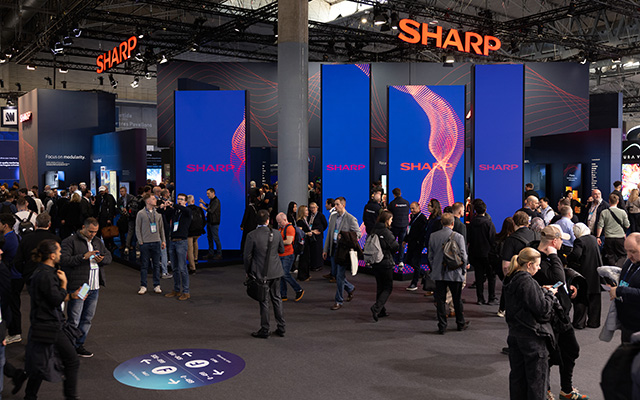
Sharp launched the LD-EC Series at ISE, bringing energy efficient flip-chip COB technology to more cost-conscious applications
Technology is becoming more energy efficient
Alongside operational improvements, advances in display technology are helping organisations reduce energy use.
New LED innovations, such as Chip-on-Board (CoB) technology, are significantly improving efficiency. Compared with traditional SMD technology, these newer solutions can reduce power consumption by up to 60%, while still delivering high brightness, long life durability and exceptional image quality.
Lower power consumption also means less heat output. This can have a secondary benefit for large installations, as reduced heat generation lowers the load on building cooling systems, helping organisations further reduce energy usage and operational costs.
Supporting sustainable growth
In a world where energy uncertainty is unlikely to disappear anytime soon, organisations are looking for practical ways to protect their operational budgets without compromising the digital experiences that modern environments depend on.
By combining energy-efficient technologies with smarter operational practices, businesses can reduce unnecessary energy consumption across their estates. The result is lower costs, reduced carbon emissions and more flexibility to continue investing in growth and innovation.