

Does sustainable AV really cost more? Sharp’s Jack Wilders on the value of thinking long term.
At AV Magazine’s AV Sustainability Summit in London, Sharp UK’s Jack Wilders challenged the industry to look beyond the initial price of AV technology and consider the environmental and financial impact of decisions over the full product lifecycle.
Hosted by AV Magazine and emap events at London’s QEII Centre on 7 October 2026, the second annual AV Sustainability Summit brought together professionals from across the AV industry to explore the practical challenges of making sustainability a more integral part of business decisions.
Following the event, Caroline Hayes reported in AV Magazine that despite growing customer demand, sustainability knowledge remains patchy across the industry. Greater education, collaboration and a more consistent approach to measuring environmental performance are needed to turn ambition into meaningful action.
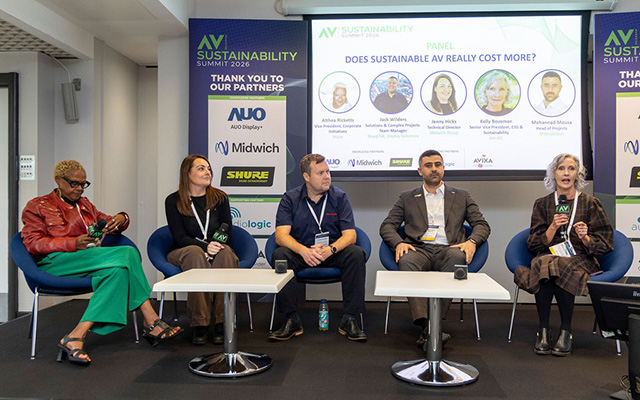
Representing Sharp UK, Jack Wilders, Solutions & Complex Projects Team Manager, joined the panel discussion Does Sustainable AV Really Cost More?, sharing Sharp’s perspective on product quality, reliability, lifecycle value and the decisions that can make a meaningful difference to environmental impact.
Jack’s starting point was straightforward: yes, sustainable technology may cost more upfront. But that is only part of the story…
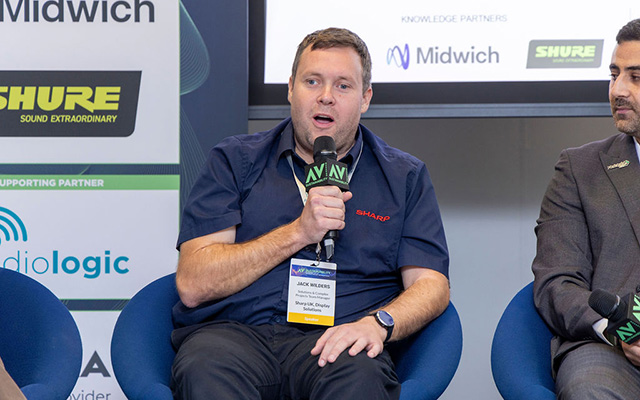
Jack Wilders speaks at the AV Sustainability Summit
Quality, reliability and sustainability go hand in hand
A lower purchase price does not necessarily mean a lower overall cost, just as a higher initial investment does not make a product more sustainable. The difference lies in how a solution is designed, how long it lasts and what it takes to keep it running.
At Sharp, quality, reliability and sustainability are closely connected. Products built with quality components and designed for long-term use can help extend service life and reduce the need for premature replacement. Keeping equipment in use for longer can also reduce the demand for new manufacturing and the associated environmental impacts.
Jack illustrated this with a particularly striking example of a display at Vienna Airport that operated around the clock for more than 20 years, demonstrating what can be achieved with the right technology and conditions.
The lesson is simple. Every time a product continues to perform as intended rather than being replaced prematurely, there is an opportunity to avoid the environmental cost of manufacturing and transporting its replacement.
That longevity starts with decisions made long before a product reaches the customer, from component selection to testing and design. Investing in components that stand up to demanding conditions can increase manufacturing costs, but it also supports the reliability and lifespan on which long-term sustainability depends.
For customers, the important question is not simply what a display costs to buy, but what value it delivers throughout its working life.
Jack presents a 20-year-old Multisync LCD4000 that has been running for 175,000 hours, 24 hours a day, delivering flight information at Vienna Airport.
Measure sustainability across the full lifecycle
One of the challenges in making sustainable purchasing decisions is how value is measured.
Total Cost of Ownership (TCO) encourages customers to look beyond the purchase price, taking account of installation, energy consumption, maintenance and product lifespan. Jack argued that sustainability deserves the same consideration.
A meaningful assessment should also consider carbon emissions, transport and logistics, waste, recyclability and what happens when equipment reaches the end of its first life.
The financial implications can be significant. Equipment that consumes less energy under comparable operating conditions can help reduce electricity consumption and running costs over its service life. Longer-lasting products can delay replacement costs, while repairable equipment and remote management can reduce service visits, travel and downtime.
There are wider commercial considerations, too. As sustainability criteria become increasingly important in procurement and tender processes, the ability to demonstrate environmental performance can influence whether a supplier is considered for a project.
Looking only at the initial price risks missing these benefits. A more useful question is: what is the net financial and operational benefit over the life of the solution?
Display Solutions for the long haul: how to maximise the value of your investment
Find out why total cost of ownership (TCO) and return on investment (ROI) should guide every purchasing decision, not just the initial price tag.
Better evidence, not just better intentions
For sustainability to influence purchasing decisions, customers need credible information they can use to compare solutions and make informed choices.
But comparing environmental performance is not always straightforward. Carbon footprint calculations can use different boundaries and methodologies, while published power consumption figures may reflect different operating conditions or exclude functionality that still draws power in real-world use.
Without consistent reporting and clearly defined assumptions, figures that appear comparable may not tell the whole story.
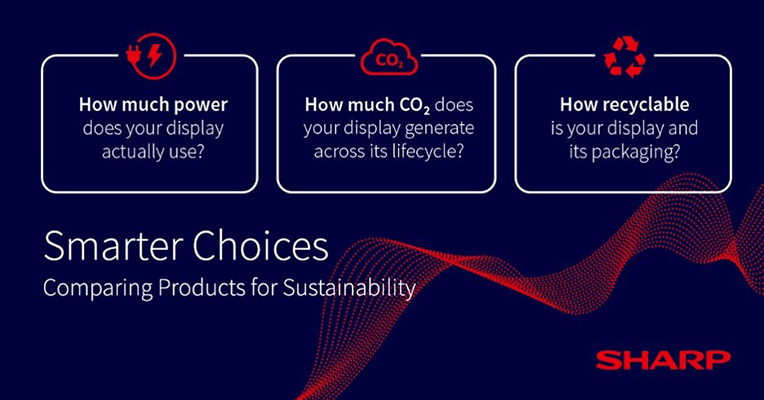
At the Summit, Jack highlighted the documentation Sharp can provide to support informed decisions, including power consumption across different operating states and modes, carbon calculations and product recyclability rates. He also called for more consistent industry standards, enabling customers to make meaningful comparisons and encouraging manufacturers to demonstrate progress against a common framework.
For Sharp, transparency means looking beyond a single headline figure and helping customers understand the factors that influence a product’s environmental impact. This includes recognising that actual energy-related emissions depend on how and where equipment is used, as well as the energy sources available.
There is no simple, universal measure that captures every aspect of sustainability. But clearer evidence, transparent assumptions and a willingness to acknowledge complexity can help customers make better-informed decisions.
As the industry works towards a more consistent approach, the priority should be to move beyond broad claims and focus on what can be demonstrated, measured and improved.
Smarter Choices: Comparing products for sustainability
When completing a tender, don’t just take figures at face value. Ask for the detail, verify the data, and make smarter, more sustainable choices. Ask your supplier these three questions.
Sustainability is a shared responsibility
Manufacturers have an important role to play in designing products that last longer, can be repaired and can be reused or recycled. But Jack also challenged customers and project teams to take responsibility for the choices they make when specifying, installing and operating technology. As he put it at the Summit: if customers are pushing us for sustainable products, we need to push them to make sustainable choices.
Project deadlines, for example, can create pressure to use air freight rather than slower, lower-impact transport options. Where timelines allow, is the environmental cost of a rushed delivery justified, or could better planning achieve the same outcome with a lower impact?
These decisions matter because sustainability extends beyond manufacturing. Procurement, logistics, installation, day-to-day operation and end-of-life management all influence the overall environmental impact of an AV solution.
The industry also needs to move beyond a simple buy-and-replace approach. Extending product life, repairing equipment and redeploying technology where possible can help reduce waste and make better use of the resources already invested.
Designing for a longer life
Sharp’s approach includes a number of ways to support longer product lifecycles and more circular use of technology.
Its open, modular computing solutions for example, allows compatible displays to accommodate upgrades to their computing technology without replacing the entire display. Interchangeable components in Sharp’s digital cinema projection range can support maintenance and repair, while certain dvLED solutions can be designed to allow pixel cards to be upgraded to a finer pitch and higher resolution, subject to product compatibility and the original system specification.
Sharp’s Second Life Warranties for large format displays provides another route to extending useful life. Eligible displays can be redeployed with manufacturer-backed warranty cover, giving integrators an opportunity to offer reused equipment as a service while providing reassurance to the next user.
These approaches can support a more circular use of technology by extending the service life of compatible equipment and creating opportunities for repair, upgrades and reuse instead of premature replacement.
Digital signage is changing, and your display should be ready for it.
The latest technology, evolving cloud platforms and increasingly intelligent software are reshaping digital signage. An open, modular approach gives organisations the flexibility to adapt while extending the life of existing display hardware.
Turning discussion into action
The Summit reinforced that sustainability is no longer something the AV industry can address through individual product claims or end-of-life recycling alone. It requires better-informed decisions, credible evidence and collaboration across manufacturers, integrators, consultants and customers.
Jack’s contribution highlighted the importance of looking at the whole picture: how products are designed, how efficiently they operate, how long they remain in service and whether they can be repaired, upgraded or redeployed rather than replaced.
Sharp takes this lifecycle approach into account from the design stage. Quality and reliability support longer product lifecycles, while technologies and programmes designed around upgradeability and reuse can help customers make better use of their investment.
As Jack puts it, the starting point when discussing a solution is always: “What is your focus?”
If sustainability is a priority, the conversation needs to go beyond specifications and purchase price to consider the right technology for the application, its expected lifespan, energy consumption and opportunities to reduce environmental impact over time.
Sustainable technology may cost more upfront, but that is only part of the story. The real value lies in looking at the bigger picture: choosing a solution that delivers the right outcome over its lifetime, minimises waste and unnecessary replacements, and offers better long-term value.
Speak to Sharp about solutions designed to support your sustainability objectives.
Sustainability in AV: Complexity, Confusion and our Commitment to Clarity
Learn more about Sharp’s perspective on sustainability data and transparency